

More than 1 in 5 students living in Lithuanian dormitories rarely or never have a quiet place to study. That is one of the worst rates among the countries that took part in the EUROSTUDENT 8 survey.
But quiet is just one of many things missing from dormitories. Lithuanian students also have to deal with damp, mould, cockroaches, broken showers and other poor living conditions.
The Lithuanian National Union of Students (LSS) has been calling for a common quality standard for higher education dormitories in Lithuania since 2020, yet the problems caused by the lack of one have so far gone unnoticed. To push decision-makers to act, LSS has asked students to share their real living conditions anonymously through the initiative “barakiniai.lt”. On the website, students share photos of their rooms and rate dormitories from “best” to “worst”.
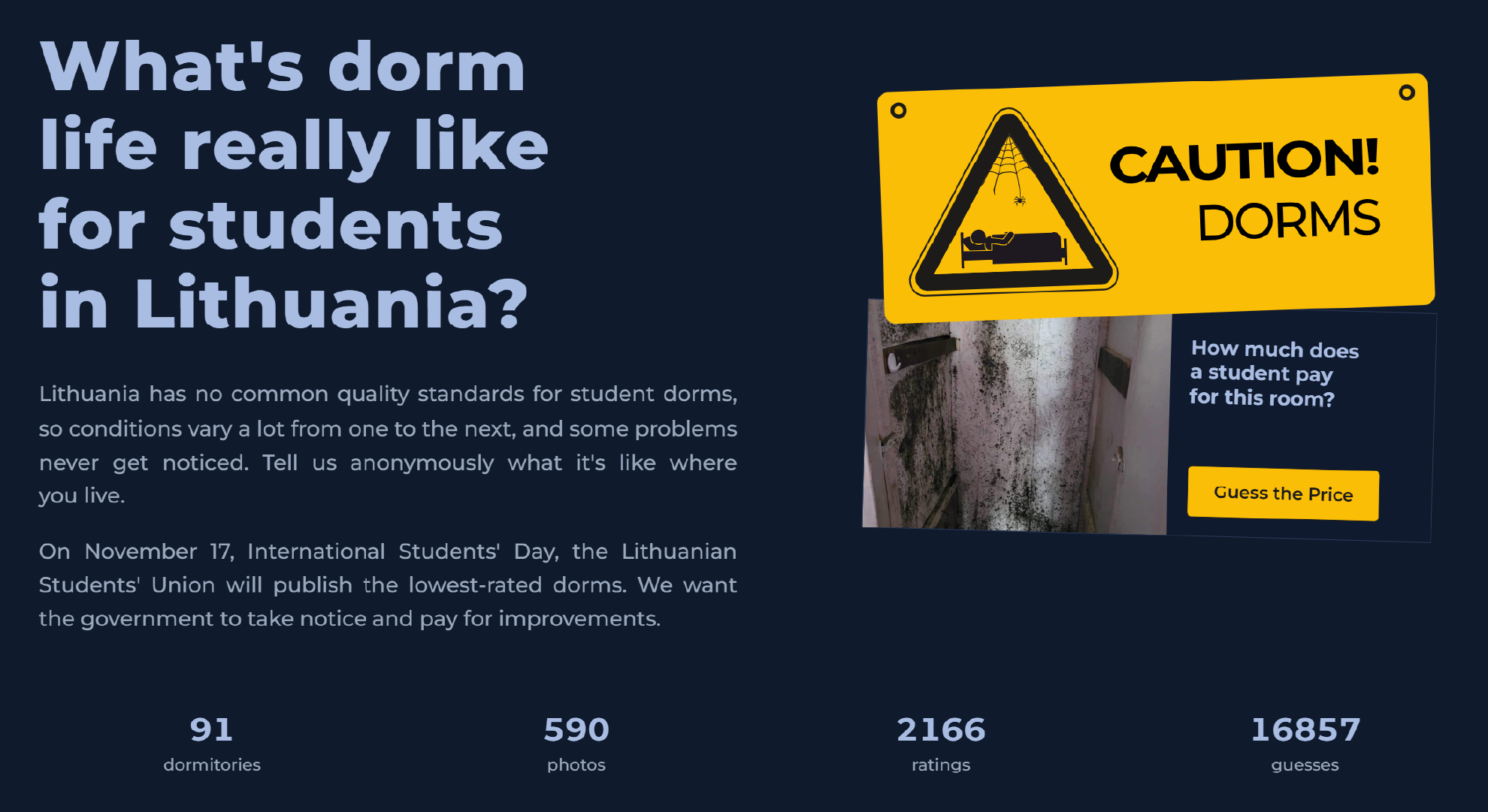
Dormitory page | Photo: barakiniai.lt
We don’t want the conversation to end with “there’s no money”
LSS plans to present the collected photos, student ratings and other material on 17 November, International Students’ Day. Prime Minister Mindaugas Sinkevičius, Minister of Education, Science and Sport Raminta Popovienė, Chair of the Seimas Committee on Education and Science Jurgita Šukevičienė, and the media have been invited to the meeting. The students hope that if the politicians agree to meet, this time the conversation about the state of dormitories will not end with “there’s no money”.
According to LSS Communications Specialist Dovydas Žurauskas: “Higher education institutions care about their image. As long as the state of dormitories is discussed only in meeting rooms, mould and fungus keep growing in students’ rooms. That is why we first need to talk about it loudly, so that the public and future students take notice.”
According to the Union, low dormitory rent is no excuse for mould. Students are responsible for the condition of the room they leave when they move out, and the higher education institution is responsible for giving them a room in good condition.
The Union openly calls the website a public wall of shame. It shows how students live, which dormitories still have unresolved problems, and which ones have prices that are “anything but student-friendly”. LSS admits the website won’t solve every problem at once, but calls it a first step towards a solution. Now that the problems have been named, government institutions and higher education institutions must take responsibility for housing students in rooms that do not meet official hygiene standards. Will the answer still be “there’s no money”?
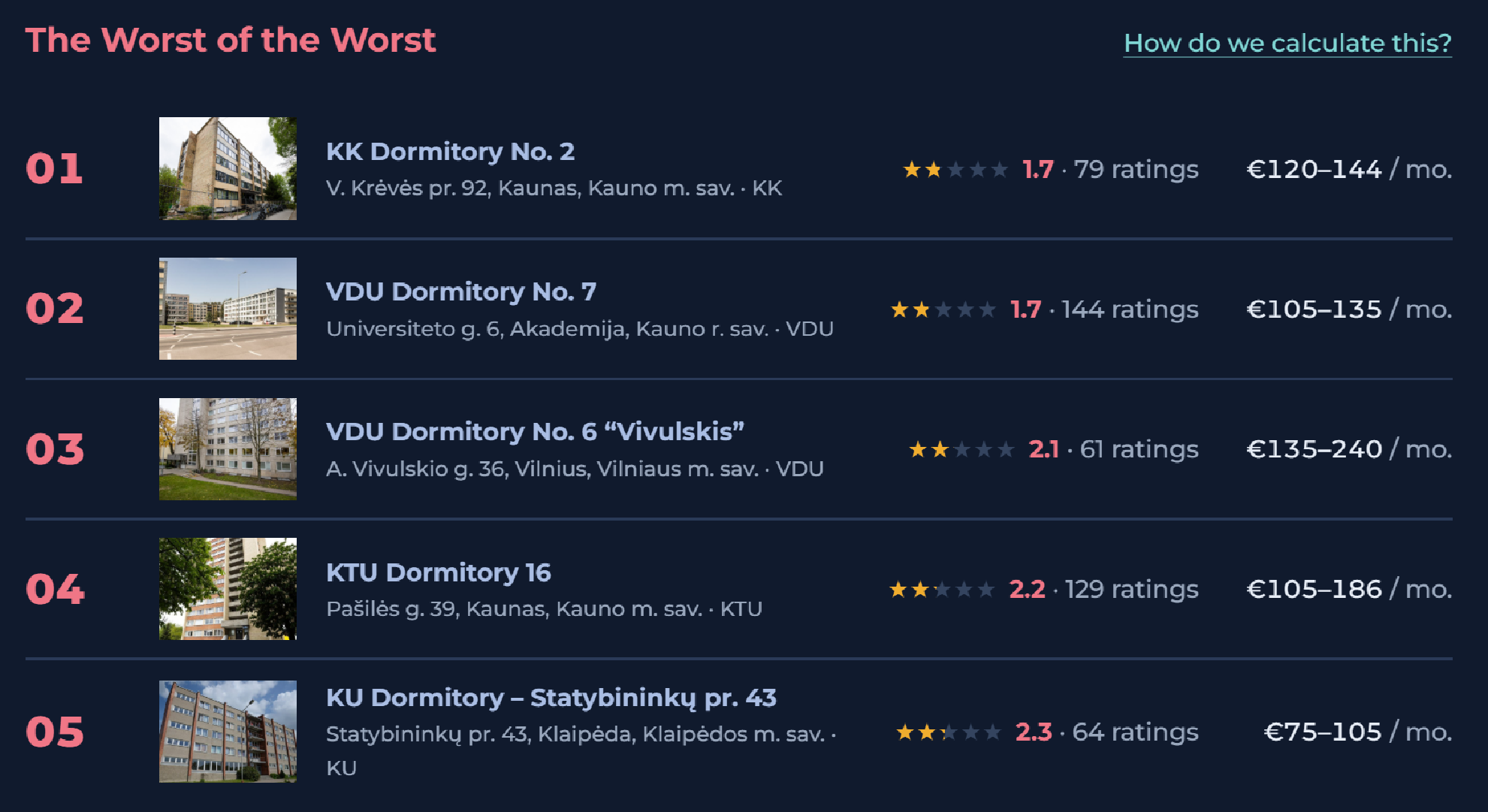
Wall of shame | Photo: barakiniai.lt
What the numbers and research show
According to the EUROSTUDENT 8 survey (2021–2024), 18% of Lithuanian students live in dormitories, which is more than the average in other countries. Students in other countries also lack quiet places to study, but much less often: the average across all countries is 12%.
| Indicator (EUROSTUDENT 8, 2021–2024) | Lithuania | Average across all countries |
|---|---|---|
| Live in a student dormitory | 18% | 15% |
| Live with parents | 31% | 34% |
| Dormitory residents who rarely or never have a quiet place to study | more than 20% | 12% |
| Average commute to the institution for dormitory residents | 24 min | 23 min |
| Average commute for students living with parents | 42 min | 49 min |
Source: EUROSTUDENT 8 data
For a student, a dorm room is both a bedroom and a place to work. If it is noisy, stuffy or damp, both sleep and studying suffer.
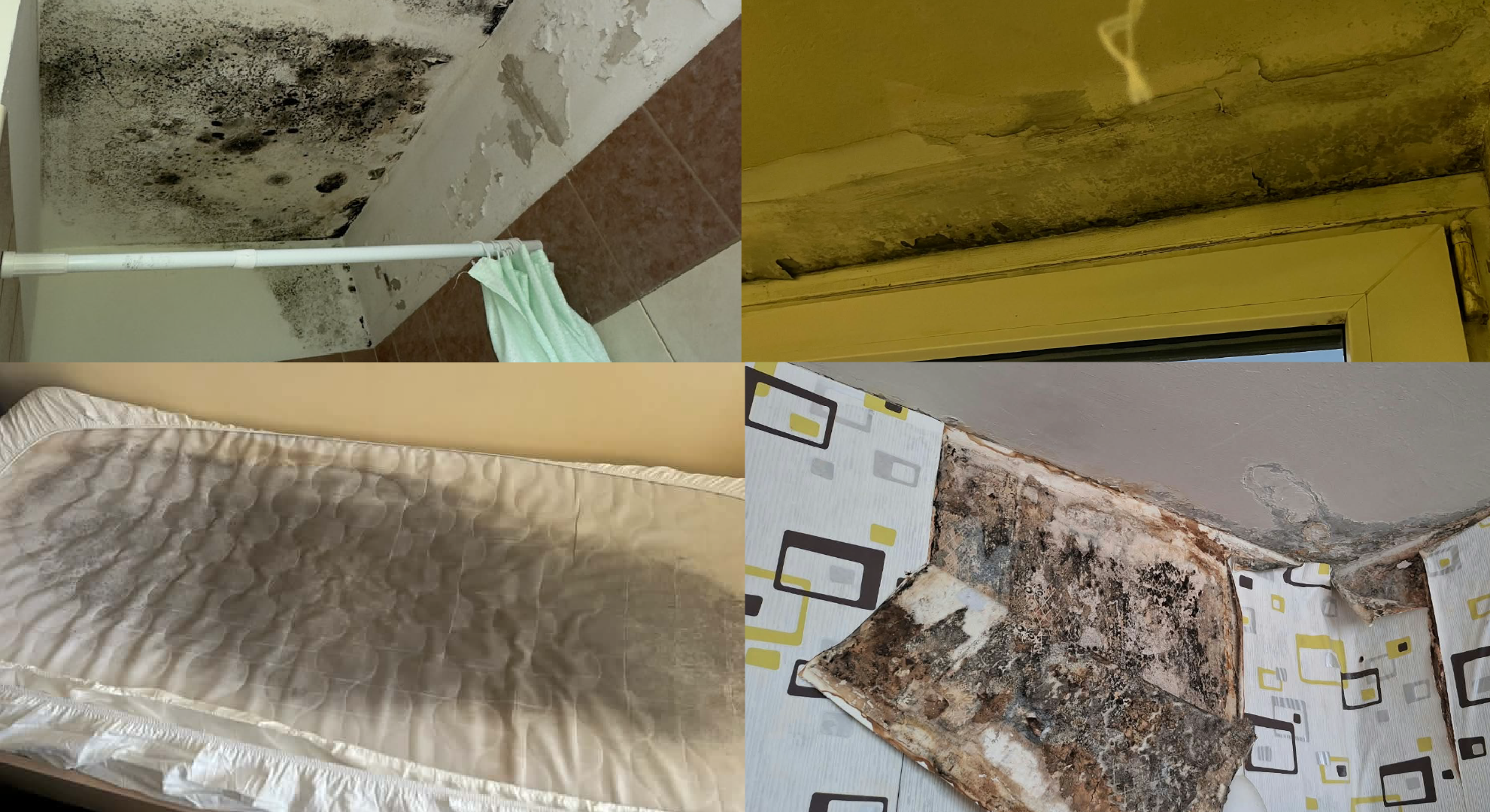
Mould in dormitories | Photo: barakiniai.lt
Danish researchers (Strøm-Tejsen et al., 2016) changed only the ventilation in dormitory rooms. That alone was enough: students slept better, felt less sleepy the next day and did better on logical reasoning tasks.
US researcher K. Broton (2021) followed students from low-income families. Those who couldn’t afford housing in their first year, or had to move often, got lower grades. Their likelihood of graduating or staying in higher education was also 8 to 12 percentage points lower. How well students do also depends on whether they can afford housing.
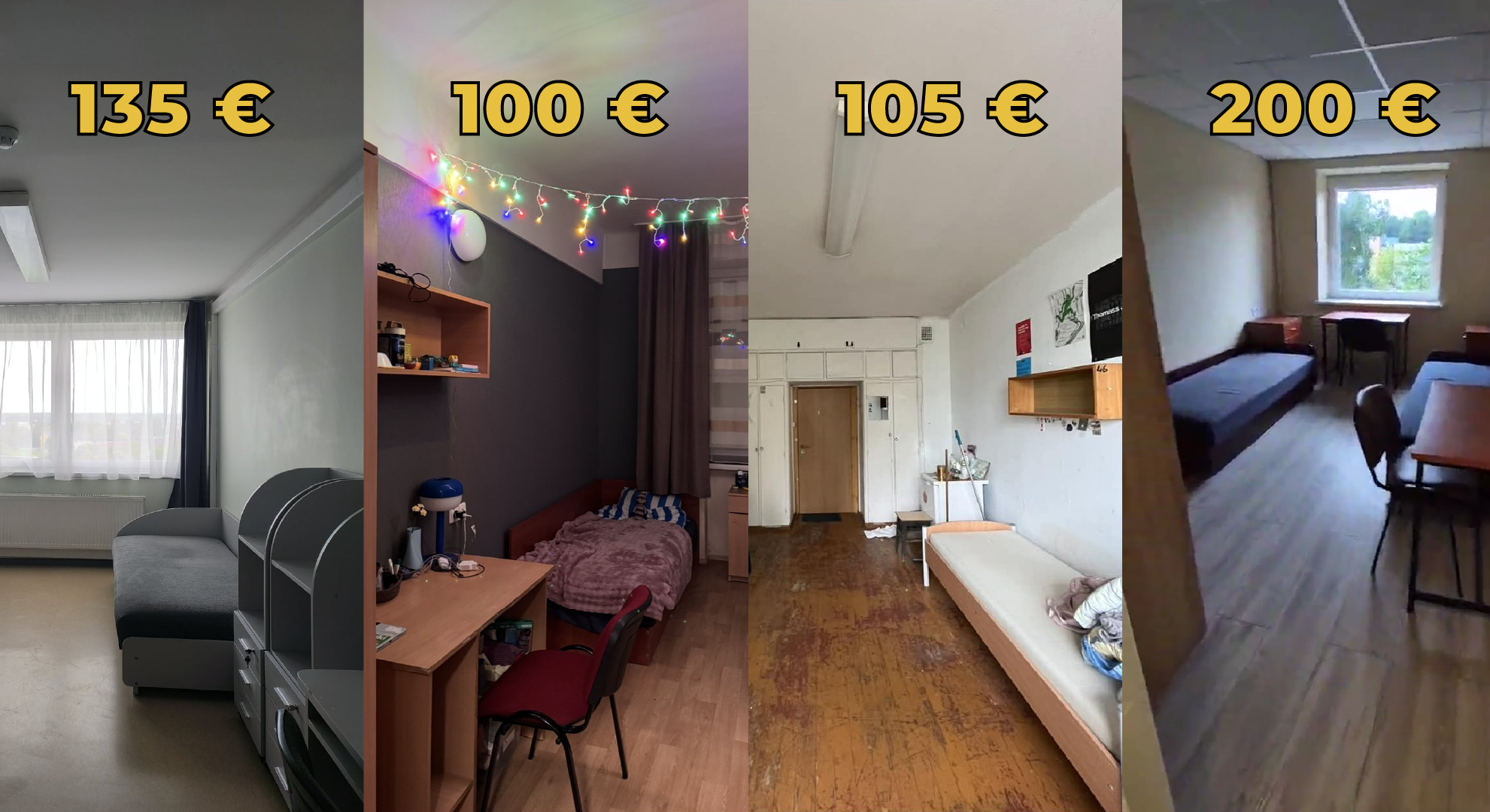
Examples of dormitories by price | Photo: barakiniai.lt
Meanwhile, dormitories get more expensive after renovation, which puts them out of reach for some students. LSS invites everyone to share all kinds of examples, to show how much dormitory quality can vary at the same price. If you don’t live in a dormitory, you can play a game on the website: guess how much a student pays for the room shown. At www.barakiniai.lt you can show your own room and rate other people’s.
